Communist Party closed unit
American PrometheusThe Communist Party closed unit was an informal, secret form of political association, not a clearly bounded organization with a roster, fixed rules, or consistent discipline. Its ambiguity lies at the center of the dispute between Haakon Chevalier and J. Robert Oppenheimer: Chevalier remembered them as fellow members of the Communist Party USA, while Oppenheimer maintained that he had never formally joined. Their disagreement was not simply over what meetings took place, but over what participation meant and who had the authority to define it.
Structure and Practice
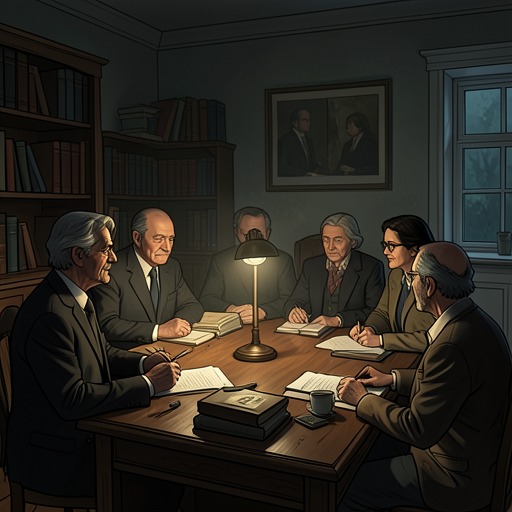
A closed unit could bring people together regularly without requiring the outward signs of formal membership. In Chevalier’s later fictionalized account, Sebastian Bloch—the physicist modeled on Oppenheimer—attends meetings and is treated by the other participants as a member, but pays no dues and makes financial arrangements with the Party outside the unit. The unit’s discussions resemble campus seminars: participants talk about ideas and theory, current events, a Teachers’ Union member’s activity, labor campaigns, strikes, and people facing attack over civil liberties.
Chevalier also depicts the unit as taking practical political action. In response to the Soviet Union’s invasion of Finland in November 1939, Bloch proposes publishing essays that explain international affairs in language suited to cultivated, critical readers. He pays the printing and postage costs and writes most of the material himself. The resulting series, called “Reports to the Faculty,” shows how a group portrayed as informal could still coordinate political work and rely heavily on the initiative of one participant.
The term did not, however, describe an organization with established membership records or a uniform measure of commitment. Chevalier explained that such secret units had no formal rosters or settled rules and little, if any, regimentation. The Communist Party USA could regard people associated with a unit as having made substantial commitments, while each individual set the limits of that commitment. Those limits could change over time, even over a short period.
Chevalier’s Accounts
Chevalier consistently remembered Oppenheimer as sharing his left-wing politics through the spring of 1943, when Oppenheimer left Berkeley, California. He described their common ideal as a socialist society, but also stressed that Oppenheimer was not an ideologue: in Chevalier’s view, he retained independence rather than following a Party line automatically.
Chevalier recast that memory in fiction. He outlined a novel in 1948 about a brilliant physicist building an atomic bomb who leads a Communist Party closed unit. Unable to find a publisher, he set the manuscript aside in 1950. After Oppenheimer’s security hearing, he returned to it; G. P. Putnam’s Sons published the novel in 1959 as The Man Who Would Be God. Its portrayal of Bloch treats the unit as a place where someone could act like a member and be recognized as one without formally joining.
The novel’s reception left Chevalier dissatisfied. In the summer of 1964, he told Oppenheimer he was nearly finished with a memoir and wanted to tell the story of their shared unit membership as he remembered it. Oppenheimer denied the allegation. Chevalier understood that denial as a warning that making the claim publicly could expose him to a libel suit. In 1965, he published Oppenheimer: The Story of a Friendship, describing the alleged closed unit instead as a “discussion group.” The changing terms—from unit, to fictionalized Party group, to discussion group—register both the dispute’s political stakes and the difficulty of drawing a firm line around an association that had no formal boundaries.
Membership and Commitment in Dispute
Oppenheimer’s position did not mean that he had been politically inactive. He funded particular causes through the Communist Party USA, including support for the Spanish Republic, farm workers, civil rights, and consumer protection. He attended meetings, offered advice, and helped Party intellectuals prepare position papers. At the same time, he had no Party card, paid no dues, and was not subject to Party discipline. Chevalier could reasonably interpret those sustained activities as evidence of membership; Oppenheimer understood his participation as political work undertaken without joining the organization.
The book leaves room for an intermediate account. Oppenheimer was probably closer to the Party in the 1930s than he later admitted or remembered, but not as close as Chevalier believed. The extent of his commitment cannot be established with confidence; what can be said is that any period of particularly strong commitment was brief and did not last. A closed unit’s informality helps explain how sincere memories could diverge: association could carry substantial meaning for one participant without amounting to formal membership in another’s understanding.
Oppenheimer’s wider intellectual life also resists the idea of a sealed political identity. He read Marx alongside the Bhagavad Gita, Ernest Hemingway, and Sigmund Freud, and the account emphasizes that his interests did not fit the rigid mental world associated with Communist Party membership. He wished to retain the freedom to think independently and make his own political choices. His central political commitment in the 1930s was work for social and economic justice in the United States, for which he chose to stand with the left.
Historical Significance
The closed unit’s uncertain status matters because later judgments could collapse different kinds of involvement into a single label. In the McCarthy era, the failure to put political commitments in perspective became especially damaging: affiliation, shared causes, attendance, and formal membership were not interchangeable, even when observers treated them as if they were. The dispute between Chevalier and Oppenheimer therefore shows how an informal association could become the basis for a much more categorical political accusation.
The book’s accounts of official atomic-policy bodies offer a useful structural contrast, not an equivalent form of organization. At the Interim Committee meeting on May 31, 1945, Oppenheimer attended as one of four scientific consultants among named government officials; the committee’s discussion took place within a formal advisory process, even though scientists had no authority over the White House’s decision on military use. In October 1949, the General Advisory Committee met over three days, heard named witnesses, and debated the hydrogen bomb; on November 9, the Atomic Energy Commission’s recorded vote on its recommendations was three to two. These documented bodies had identifiable participants and official outcomes. The closed unit, by contrast, depended on informal association and remembered commitment—precisely the conditions that made its meaning contested.